
Selling photography prints isn’t your problem. Building your whole business around them is.
As an independent artist, you can post great images, collect likes, and hear “your work is beautiful” all week long without making consistent income. That doesn’t mean your photography isn’t good enough. It means attention isn’t the same as demand.
Here’s where most landscape, travel, and wildlife photographers get stuck.
Key Takeaways
- Attention, likes, and compliments do not necessarily translate into demand for photography prints.
- Prints are often optional purchases with tight margins, physical fulfillment costs, and limited scalability.
- Photographers can build stronger businesses by selling the skills, knowledge, and processes behind their images.
- Digital products such as courses, guided workflows, and coaching can solve real problems without inventory or shipping.
- Prints can work better as a secondary offer after you’ve built trust, authority, and genuine collector interest.
Why prints don’t sell: The familiar plan that rarely creates income
The plan sounds reasonable at first.
You make strong images. You post them online. You build an audience over time. And somewhere in the background sits the idea: “Eventually, I’ll sell prints.”
Then the likes arrive. Other photographers praise the work. People tell you they love your images.
But the print sales don’t follow.
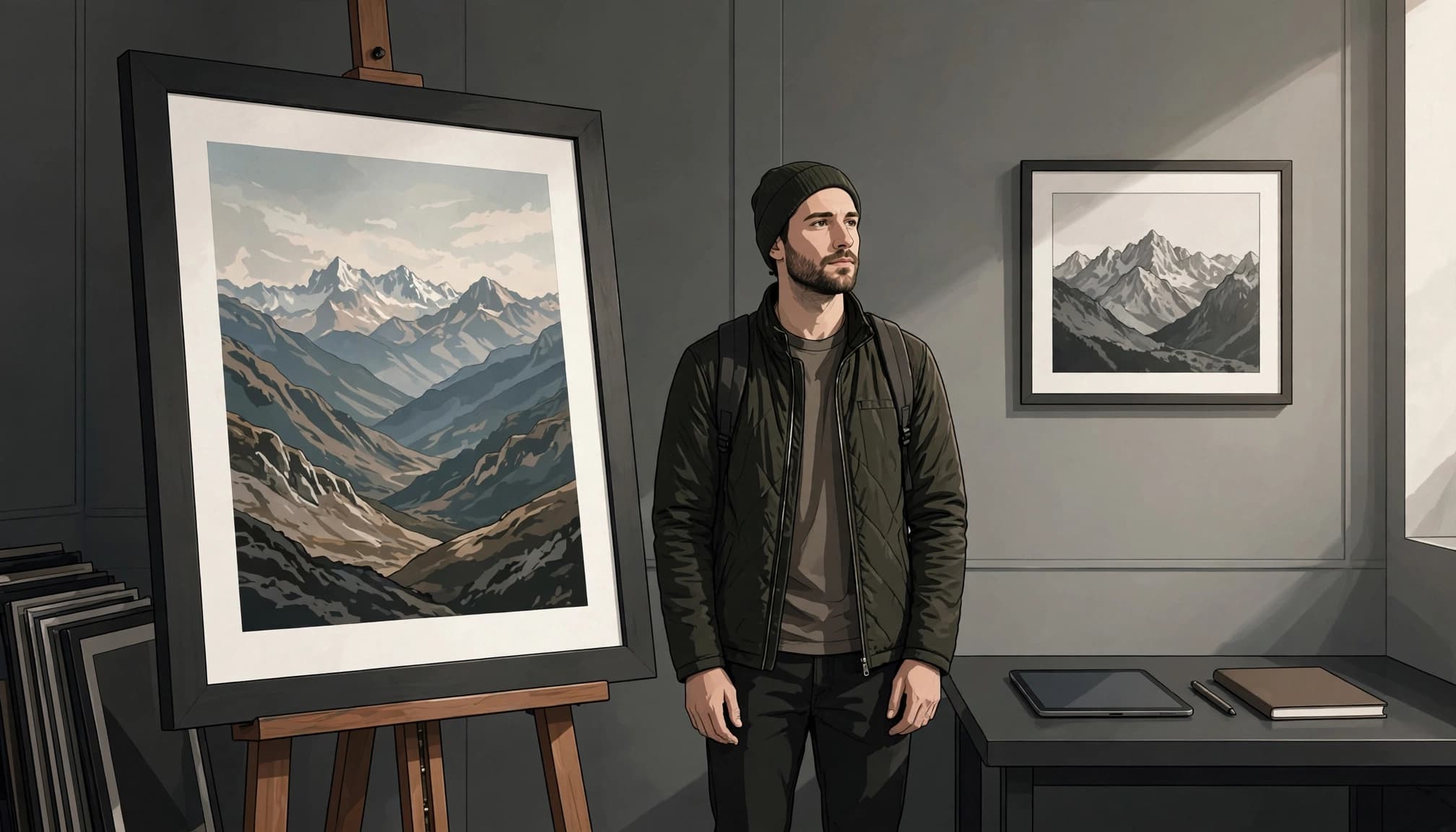
The hard part is that much of that engagement may come from other photographers. They can admire the image, understand the work behind it, and still have zero interest in buying a print for their wall.
Your audience may appreciate your work without being actual art buyers.
Better photos won’t fix the wrong offer
When print orders don’t happen, the usual response is to push harder.
Post more often. Make better images. Open a new print shop. Change the website.
Offering more affordable prints or uploading daily won’t overcome market oversaturation if you’re pitching to people who simply aren’t looking to buy decor. The issue may not be your photography. It may be the business model built around it.
A like shows appreciation. It doesn’t prove someone wants to spend money on a print.
Prints are a difficult place to start
Most decor prints are a nice-to-have. They decorate a wall, but usually don’t solve an urgent problem.
Outside the traditional fine art print market, high-end art galleries and dedicated art collectors set a different standard. Supporting a living artist solely through prints is mathematically challenging.
Original works of art and artisanal hand-pulled prints offer physical uniqueness. Modern mechanical prints and giclee reproductions can have excellent print quality, but they don’t provide the same tangible scarcity collectors seek.
Limited editions can signal scarcity through documented edition numbers and an artist signature. Open editions have no fixed limit, so their supply and demand rarely support collector-level pricing.
Compare that with an offer that helps someone improve a skill, make better photographs, or create something they care about. The perceived value is different.
That’s why someone can pay more for a course than for a print without questioning it. The course feels like progress. The print feels optional.
The economics get tight fast
Prints are expensive to produce, hard to scale, and easy for a customer to ignore.
Even when printing is outsourced, the money gets eaten up by production, shipping, and platform fees. The remaining sales margin can be very thin. Then many photographers underprice because they’re worried that nobody will buy at a higher price.
That puts you in a bad position:
Low demand + thin margins = frustration.
I learned this the expensive way. On my first photography website in 2008, I posted image after image and hoped people would buy prints. Framed prints sold for around $400. Unframed prints sold for around $300.
But each order meant printing and framing work that took at least two hours. Shipping within Norway was roughly $20 to $30. And that was before accounting for repeated multi-hour field trips, many of which produced no usable photograph at all.
A few prints sold. The profit left after the full effort wasn’t enough to build a business around. So I stopped.
More physical product sales usually mean more work
With physical products, every additional sale carries more cost and more effort.
There is another order to fulfill. More shipping. More production. More things that can go wrong.
That doesn’t make prints bad. It means they don’t give you much room when you’re trying to build reliable income from scratch.
Sell the skills behind the image
The better question isn’t:
“How do I sell this photo?”
It’s:
“What can I teach because I took this photo?”
That’s the shift.
Few online followers are looking to build a curated art collection of original works of art. Most want to create better photographs themselves. They want to understand composition, edit with more confidence, and know where to go and when to shoot.
Those are real problems. And people actively look for help with them.
A print buyer admires you. A student trusts you.
When somebody buys a print, they admire what you created.
Whether it’s a mechanical print sold as a limited edition or an open edition, the buyer is purchasing an image for display. A student buys your knowledge because they trust you to help them improve.
That trust is where a business starts to become more than occasional sales.
Your field knowledge, editing decisions, planning process, and creative judgment are not separate from your photography. They’re part of what made the image possible in the first place. The craft may appeal to buyers of hand-pulled prints, but digital knowledge products scale much better than any physical print format.
| If you sell a print | If you sell knowledge |
|---|---|
| The buyer gets an image for their wall. | The buyer gets help making progress. |
| Each sale comes with physical costs. | The product can be created once and sold repeatedly. |
| Your market can be limited by shipping and logistics. | You can help people anywhere. |
| More sales often create more fulfillment work. | More sales can create more profit without the same extra workload. |
The point isn’t that prints have no place. The point is that teaching can give your business a stronger foundation.
Why digital products change the math
Digital products remove many of the problems that come with print sales.
No inventory. No shipping. No production cost taken from every individual sale. You don’t need to produce art books or prepare rolled mechanical prints for each order. You make something once, then it can be sold again and again.
That changes the economics fast. Digital product selling models are built around delivery without the physical fulfillment required for prints.
Learning feels like progress, not decoration
Photography is one of the biggest self-improvement hobbies in the world. People want to become better at it.
A good course, guided workflow, or coaching offer doesn’t feel like a luxury purchase in the same way a print does. It feels like progress.
And people pay for progress.
That doesn’t mean you need to teach everything you know. It means you need to help somebody get past one problem they already have.
Your market isn’t limited to people near you
Physical prints come with practical limits. Shipping costs money. Logistics get annoying. Some customers won’t buy because the process feels like too much hassle.
Whether you’re packing shipping tubes for online buyers or hauling inventory to the convention circuit, physical products create continuous logistical overhead.
Knowledge doesn’t have the same limits.
You don’t need to travel to deliver it. You don’t need to pack it. You don’t need to cap the number of people you can help because you ran out of stock.
With digital products, more sales can mean more profit without the same increase in workload. That’s how a business grows without burning you out.
“I’m not a teacher. I’m a photographer.”
This is where many photographers hesitate.
“I’m not a teacher. I’m a photographer.”
Fair enough. But if you share your work online, you’re already teaching.
A caption can explain why you chose a composition. A behind-the-scenes post can show how you planned a shoot. An editing breakdown can show how you think through an image.
You might discuss modern digital capture, specialized printmaking processes, or the historical differences between hand-pulled prints and mechanical prints. Sharing that technical craft demonstrates authority.
You don’t need to know everything
Turning that knowledge into a structured product isn’t a completely new skill. It’s a more intentional version of what you’re already doing.
And no, you don’t need to know everything.
You only need to know more than the person you’re helping.
That matters because plenty of photographers buy gear when what they really need is help using what they already own. I’ve seen guests arrive on a once-in-a-lifetime expedition with a camera bought days before departure, often because someone told them their old camera wasn’t good enough.
The worst time to learn a complicated new camera is during the trip of your lifetime.
The camera may have more capability. But without confidence and guidance, it doesn’t solve the problem.
Start small and make it useful
Don’t turn this into another massive project.
Look at your own workflow and ask where beginners struggle most. Maybe it’s planning shoots. Maybe it’s composition. Maybe it’s editing.
Pick one problem.
Then build one simple offer around it:
- A short course that teaches a focused skill.
- A guided workflow that helps someone move through a process.
- A small coaching offer for photographers who need direct help.
You don’t need a huge product. You need something useful. Starting with a digital tutorial is simpler than self-publishing coffee-table “art books” or manufacturing large batches of “limited editions.”
Useful beats impressive every time.
Don’t build the course because you want a course
This part matters.
I once built a Lightroom course because I used Lightroom and thought a course would be a good business idea. The offer became broad. The audience was broad too. A broad course can create the same inventory risk as printing hundreds of unsold art books, even when the inventory is your time and energy.
I had nearly 2,000 subscribers and webinar attendees, but many used free editing software or a cheaper Lightroom alternative.
The beta cost $299. I expected 15 to 20 customers without making a proper sales estimate. Five people joined, bringing in $1,495. I saw that as disappointing at the time, even though those five customers completed the program and gave very good feedback.
Looking back, the problem wasn’t that five people paid. The problem was that I had not validated whether the audience and offer fit before building the thing.
More modules wouldn’t have fixed that.
Build trust before you push prints
Most photographers get the order backward.
They try to sell prints before they have enough trust, demand, or a real audience that sees them as more than someone posting good images. Generic open editions rarely change that.
Flip it.
Build trust. Solve problems. Create value. Teach what you know.
Later, when people already respect your work and trust your expertise, limited editions with verified edition numbers can create real collector interest. That interest follows natural supply and demand, rather than appealing to an indifferent market.
Your photographs haven’t changed. Your position has. Established authority can even create value on the secondary market.
Prints can still have a place
None of this means selling prints is wrong.
Premium physical products, such as curated art books or exclusive limited editions, can become natural secondary offers once people trust your vision.
But prints are a weak place to start if you need an offer that:
- Builds trust.
- Solves real problems.
- Scales without burning you out.
Digital products can do all three. Prints rarely do, at least not in the beginning.
Frequently Asked Questions
Why don’t my photography prints sell?
Likes and positive feedback show appreciation, but they do not prove that people want to buy wall art. Your audience may enjoy your images while having no interest in collecting prints.
Are photography prints a bad business idea?
Prints are not inherently bad, but they can be difficult to scale because of production, shipping, fulfillment, and thin margins. They often work better as a secondary offer than as the foundation of a new photography business.
What should photographers sell instead of prints?
Consider selling the knowledge behind your images through a focused course, guided workflow, or coaching offer. These products can help people improve their photography while avoiding the physical costs of print fulfillment.
Do I need to be an expert or professional teacher to create a digital product?
No. You only need to know more than the person you’re helping and be able to guide them through a specific problem. Your planning process, editing decisions, and field experience may already contain valuable lessons.
When can prints become a stronger offer?
Prints can become more attractive after you’ve built trust, authority, and an audience that values your vision. At that point, curated art books or verified limited editions may create genuine collector interest.
Sell what helps people move forward
If you keep trying to make wall decor sales happen through more posts and better images, you may be working hard on the wrong part of the business.
Your images matter. They prove you can do the work. But the knowledge behind those images can be the thing people are more ready to buy.
Build around that first.
Are you trying to sell what looks good, or what actually sells?