If you make one offer, get no sales, and decide people don’t [...]
Photography marketing

Photography marketing
If you make one offer, get no sales, and decide people don’t [...]
Photography business
Selling photography prints isn’t your problem. Building your whole business around them [...]
Photography business
A beautiful photograph doesn't automatically become a sustainable photography business. The business [...]
Photography business
You can be highly skilled at landscape photography and still make no [...]
Photography marketing
You can complete three Instagram posts, one reel, a YouTube video, and [...]
Social media
Landscape, travel, and wildlife photographers share beautiful landscape photography every day, then [...]

If you make one offer, get no sales, and decide people don’t want it, you may be drawing the wrong conclusion.
Most people who see your work aren’t ready to buy today. They’re curious, unsure, comparing options, procrastinating, or thinking, “Maybe later.” No sale today doesn’t always mean no interest.
Why people buy often comes down to timing, trust, perceived relevance, and readiness. Marketing psychology helps explain why a lack of immediate sales may reflect the wrong stage, not a lack of interest.
That changes what your marketing needs to do.
Photographers often treat marketing as a way to convince people to buy. It isn’t. Marketing is mostly about meeting people where they are.
You post something once. You make an offer. Nothing happens. Then comes the familiar thought: “People don’t want this.”
Maybe they don’t. But maybe they aren’t ready yet.
You’ve probably heard the 5% figure, the idea that only a small percentage of an audience is ready to buy at any given time. It isn’t a law of physics. Nobody in a white lab coat discovered it between two cups of coffee. But it’s a useful lens for consumer purchasing behavior.
Most people aren’t sitting there with their wallet open, waiting for you to drop a link. They’re trying to work out what they need first.
That is part of buying psychology. Before committing, prospects often try to reduce uncertainty, avoid effort, and escape pain. These are broad tendencies, not reasons to manipulate people.
That is why shouting “buy my thing” every week doesn’t work very well.
The mistake is talking to your audience as if everyone is in the same place.
They aren’t.
Some people have only started to notice a problem. Some know the problem but are looking at different solutions. Others are close to buying but need one last reason to trust you.
That is the buyer’s journey. Yes, it sounds like something a marketing consultant says while pointing at a very serious PowerPoint slide. The idea itself is simple: people move through stages before making buying decisions.

A person in each stage needs a different conversation. Someone who has only realized they have a problem is unlikely to respond to a full sales pitch. Someone comparing options needs guidance. Someone ready to act needs a clear offer and a reason to trust it.
The mistake isn’t selling. The mistake is expecting awareness-stage people to respond like decision-stage buyers.
At the awareness stage, people know something feels off. They may not know what they need yet.
A newer photographer might be thinking:
They aren’t looking for your full course, mentoring package, workshop, or print collection. Not yet.
They’re looking for language. They want to understand what is wrong.
A problem agitate solve structure can help. First, name the problem, show why it matters, then point toward a possible solution without jumping into a pitch.
This is where your content can help someone think, “Oh. That’s me.”
You might explain:
Awareness content can also reveal the emotional reasons why people buy. These may include identity, connection, social status and prestige, or emotional gratification, depending on the person and the offer.
That recognition matters because people don’t buy solutions for problems they haven’t admitted yet.
Awareness content helps people understand the problem before you ask them to buy the solution.
Once people know they have a problem, they start looking for options.
They know their current approach isn’t working. Now they are asking what to do next. Should they build an email list? Start YouTube? Run workshops? Create presets? Sell a course? Offer coaching? Improve their website? Post more on Instagram?
At this stage, prospects weigh rational considerations such as fit, budget, expected results, and whether an option can save time and money or help them escape pain.
The internet is one giant room full of people yelling different advice. Every person yelling seems very confident. Annoying, isn’t it?
At this stage, your job isn’t only to sell. Your job is to guide.
For a landscape photographer, teaching beginners may be easier to sell than prints. A small email list filled with the right people can be more useful than a large Instagram following full of photographers who never planned to buy wall art.
A simple problem agitate solve structure can connect an offer to a clearly felt problem. It shows people what’s wrong, why it matters, and how your option helps.
Workshops, digital products, and coaching can also solve a clearer problem than “please buy my beautiful print.” Coaching or education may promise personal transformation, while a carefully scoped offer can sit among high-ticket premium services.
Package design matters, too. The decoy effect can help clarify the difference between tiers when used ethically, but it shouldn’t trick buyers into choosing an option.
For prints and premium art, social status and prestige may matter to some buyers. Others care more about utility, personal meaning, or how the image makes a room feel.
That doesn’t mean prints are bad. It means you need to be honest about what each offer is asking people to buy and why they would want it.
Consideration content helps someone think:
“This makes sense. I can see the path now.”
At the decision stage, someone knows the problem. They understand the available options. Now they’re trying to decide whether your solution is right for them.
This is where the offer matters. A strong landing page strategy makes the promise, audience, proof, pricing, and next step easy to evaluate. It should make value for money clear, with examples, customer testimonials, social proof, bonuses, guarantees, and a clear next step.
Clear package comparisons also help buyers choose. Ethical anchor pricing can establish a useful reference point, while the decoy effect can make differences between options easier to understand. Neither requires artificial pressure or confusing tiers.
A direct sales post has a job here. It can support planned purchases, while creative prints and workshops may also prompt impulse purchase behavior or unplanned purchases through emotional gratification. Fear of missing out belongs only in messages about genuine deadlines or limited availability.
There’s nothing wrong with those posts. You need to make offers. People who are ready to buy need to know how.
The problem starts when decision-stage posts are all you publish.
Then you’re only speaking to the small slice of your audience that’s ready right now. Everyone else gets skipped over.
They don’t necessarily dislike you. They may not be rejecting your offer. They may need a different conversation before that offer makes sense.
A healthy business does both:
Social media is good for discovery. It can put your ideas in front of people who have never heard of you.
Email is where you have room to nurture people through the journey.
A newsletter can help someone move through a series of thoughts:
That doesn’t happen because of one pretty post. It happens through repeated, useful, honest communication.
Clear, helpful emails help readers avoid effort when researching their options. Over time, that trust can build brand loyalty and increase customer lifetime value through repeat purchases, referrals, or later services.
I learned this the hard way. Despite years in sales and marketing, I started online photography by posting image after image and waiting for print orders.
I sold a few. But the time spent making the photographs, printing, framing, packing, and shipping left little profit. Email can save time and money by creating a dependable follow-up channel. It also reduces the need to restart the sales process with every prospect.
Social media can attract potential customers. It doesn’t replace a nurture system or make unplanned purchases predictable.
Your job isn’t to convert every person who sees your content. Some people will never buy. Fine. The goal is to build trust with the right people long enough that, when they are ready, you are the obvious choice.
You don’t need a huge audience. You need the right audience at the right stage.
A large audience full of people who don’t understand the problem, don’t want your solution, or don’t trust you yet won’t save the business. It will only give you more people to disappoint you. Lovely.
A smaller audience where people feel understood can become a real business.
This is why a large list or a big following can create false confidence.
I once built a Lightroom course for a broad photography audience. Nearly 2,000 people had subscribed, and webinars had decent attendance. The course beta was priced at $299. Five people bought.
My first reaction was disappointment. Looking back, five people paid for an offer I had not properly validated, and they gave good feedback. Better consumer research before building the offer might have exposed the mismatch.
Many subscribers wanted free tools or cheaper alternatives. They weren’t judging the course’s value for money in the same way as committed Lightroom buyers. Social status and prestige might matter when someone buys premium art or prints, but it wasn’t driving these Lightroom learners.
The number of people doesn’t reveal their motivation or fit. The fit is the point.
Once you understand the buyer’s journey, every post doesn’t have to make a sale today.
Some content creates awareness. Some builds trust. Some helps people compare options. Some makes the offer. Together, these become sales strategies tied to different buyer stages.
| Content stage | What the person may be thinking | What the content needs to do |
|---|---|---|
| Awareness | “Why am I not getting clients?” | Help them name the real problem. |
| Consideration | “Should I build an email list or start YouTube?” | Organize confusing choices and help them avoid effort. |
| Decision | “Is this workshop or coaching offer right for me?” | Make the offer, proof, and next step clear. |
A post can do its job without creating an immediate sale.
An awareness post may use problem agitate solve to name the problem, show its consequences, and offer a next step without forcing a sale. A consideration post may make their next move less confusing. A decision post can support deliberate purchases and unplanned purchases by making the offer and next action clear.
Instead of asking, “Why didn’t this sell?” ask:
“What stage was this content for?”
That one question can save you a lot of frustration.
If the content was for people who have only started to recognize a problem, immediate sales were never the right measure. If it was for people comparing options, clarity may have been the job. If it was a direct offer, then it should help ready buyers act.
Not every post needs to close the sale. But every post should know what it is trying to do.
The real mistake is expecting decision-stage results from people at the beginning of the journey.
Someone who has only realized they have a problem probably isn’t ready to buy your full offer today. They may be ready to read your newsletter, download a guide, follow your thinking, or trust you a little more.
That is not nothing. That is the beginning of the sale.
Most sales don’t begin when someone clicks “buy.” They begin much earlier, when someone reads something you wrote and thinks:
“Finally. Someone gets it.”
Most people who see your offer may not be ready to buy yet. They could still be recognizing the problem, comparing options, or deciding whether they trust your solution.
Create awareness and consideration content that helps people understand their problem and evaluate possible solutions. This builds trust and keeps your business relevant until they are ready for a direct offer.
The three stages are awareness, consideration, and decision. People first recognize a problem, then compare solutions, and finally decide whether your offer is right for them.
Social media is useful for discovery, but attention alone is not a complete sales system. Email and other follow-up channels give you more opportunities to build trust and continue the conversation.
Not necessarily. A smaller audience with a strong fit and a clear understanding of the problem can be more valuable than a large group of people who are unlikely to buy.
Most of your audience won’t buy today. That doesn’t mean they are the wrong audience. Many can become ready later if you don’t lose them first.
Build content for people who are becoming aware, comparing options, and ready to act. Trust is built before the offer is accepted.
Keep serving people with consistent, relevant communication throughout the journey to build brand loyalty over time. When you stop expecting every post to make a sale, marketing becomes less desperate.

You can complete three Instagram posts, one reel, a YouTube video, and a blog article, then arrive at Friday with every box checked and nothing moved. No new email subscribers. No buyer conversations. No sales.
A publishing schedule isn’t a photography marketing strategy without a buyer, an offer, and a next step. That’s not a motivation problem. It’s what happens when your plan is a publishing schedule instead of a photography business marketing plan.
You can put this plan on one page in about an hour, then review it every Friday.
Publishing feels safe. You can measure it. You can tick it off. Choosing your target audience, naming their problem, creating an offer, and asking for a sale feels riskier.
Before choosing channels, define one or two ideal client personas. You might also choose a focused photography niche within landscape, travel, wildlife, or nature photography.
So you end up with a list of channels instead:
Those are execution tools. They aren’t a strategy.
Social media marketing only matters when it has a defined job in the customer path. Blog posts, educational videos, and useful social posts are content marketing when they attract or educate a specific buyer.
A marketing plan is a set of connected decisions about who you want to reach, what you want them to buy, and how you will move them toward it.
Every channel needs a job. It might attract the right people, build trust, collect email addresses, start buyer conversations, or present an offer. If it has no clear job, you’re keeping it busy for the sake of being busy.
A post view can create awareness. That has value. But a view isn’t the same as an email signup, a reply, a buyer conversation, an offer-page visit, or a purchase.
Not every post needs to create a sale. Your customer path can take time. But you should know what each piece of work is meant to change.
The path from first attention to a purchase is often called a marketing funnel. For your photography business, it doesn’t need to be complicated. It does need to exist.
Write down every platform and activity you maintain. Then write one job beside each one.
If you can’t explain how a channel helps move someone from attention to trust to purchase, pause it. Reduce it. Remove it.
A smaller system you can explain is more dependable than trying to keep up with every platform people tell you to use.
Your one-page photography business marketing plan has six lines:
| Line | What you decide |
|---|---|
| Buyer | Who you want to reach |
| Problem | What they need help with |
| Offer | What you want them to buy |
| Promise | The useful result they can expect |
| Path | How they move from attention to purchase |
| Weekly numbers | What you will review each Friday |
Don’t fill this in with broad labels like “everyone,” “better photography,” or “grow online.” Write in plain language. Each answer should lead naturally to the next one.
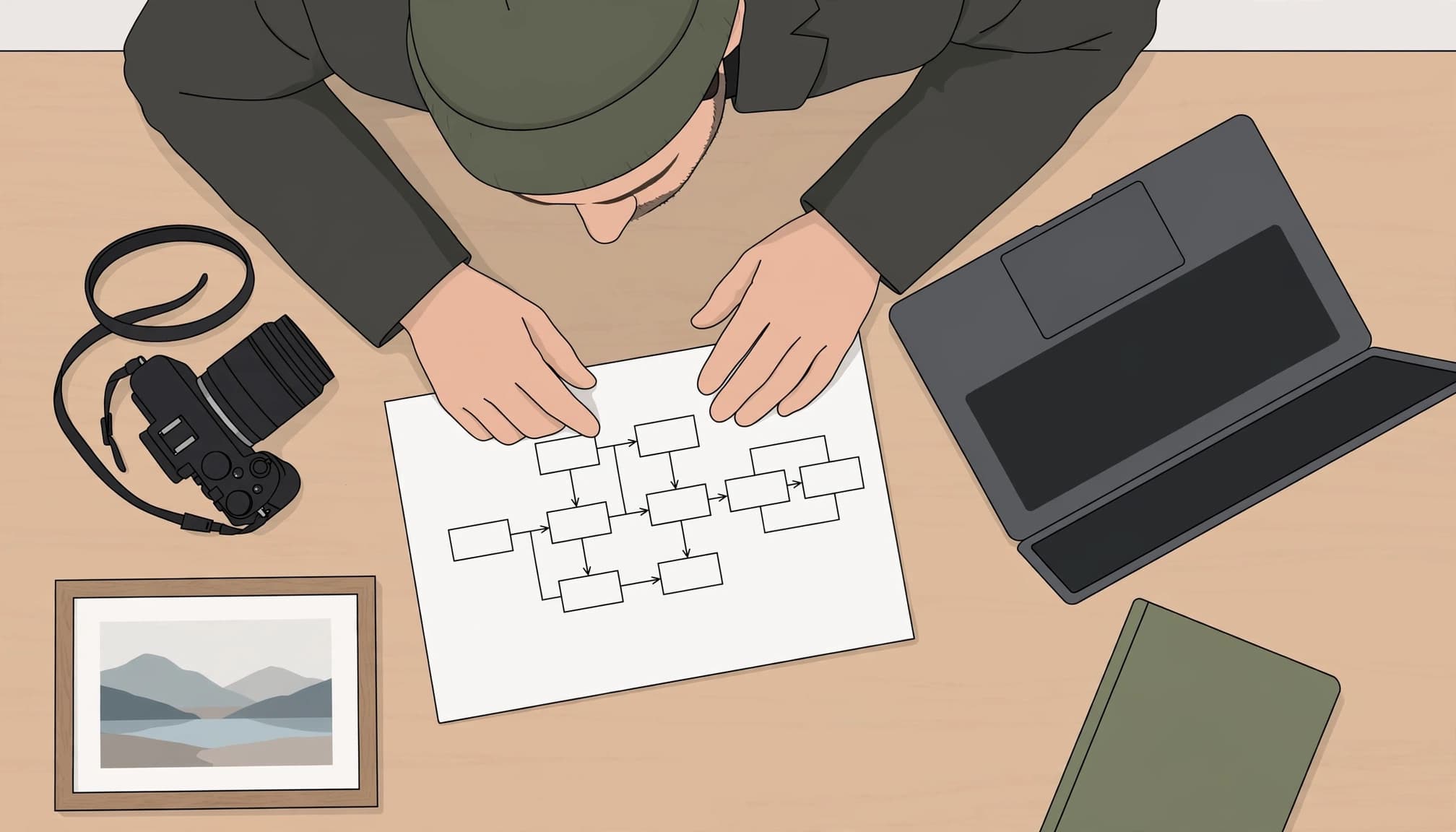
Choose a narrow group within landscape, travel, wildlife, nature, or portrait photography. Wedding photography may serve a different buyer than landscape instruction. Don’t start with the product you want to make. Start with the person you want to help.
Name what that person is trying to do. Name what keeps going wrong. Think about what they’ve already tried and where they get stuck.
Use lightweight market research to find those details. Review customer questions, conduct a few interviews, and note the language people use. Your professional network may also reveal common needs, referrals, and buyer concerns.
They may be preparing for a major trip. They may struggle to create a cohesive online portfolio instead of a collection of unrelated images. They may want to teach what they know but have no clear offer.
You aren’t trying to help every photographer. You’re trying to become useful to the right one.
Next, name one concrete offer. It could be a workshop, course, mentoring package, critique service, field guide, mini photo sessions, or print sales. A photography website should clarify the problem, promise, and buying path, not simply display images.
Then state the result the buyer can reasonably expect. Don’t describe a pile of lessons, modules, or features. Describe the change your offer helps create, whether that improves their images, business outcome, or client experience.
Tie the presentation of that result to a consistent brand identity. Your offer can come from experience you already have. Field knowledge. Creative decisions. Editing skills. Teaching ability. The things you do without thinking much about them may be the things another photographer needs help with.
Different offers need different buyers, promises, and sales paths. Wedding photography, portrait photography, mini photo sessions, and print sales each attract people with different reasons to buy.
A broad audience doesn’t automatically make an offer easier to sell. A Lightroom course can attract plenty of people interested in free photography education, while only a small number use Lightroom or want to pay for focused help. List size isn’t the same as buyer fit.
The fifth line is the part most content calendars leave out.
Write the next steps a potential buyer takes after they find you. Keep it simple enough that you can see the whole thing at once.
For example, your path might look like this:
Each step has one job. A post doesn’t need to teach everything, collect an email address, handle every objection, and make a sale at the same time.
A useful article can support search engine optimization while attracting photographers who actively search for portfolio guidance. A local photographer might use local seo to reach nearby prospects instead, while this example relies on educational content.
Paid advertising can send qualified traffic to the guide or offer. It shouldn’t compensate for an unclear buyer or weak promise.
Say you want to help experienced landscape photographers who struggle to turn individual strong images into a cohesive online portfolio.
Your offer could be a focused portfolio-review workshop. Your promise is clearer project direction and stronger image selection. Your pricing strategy should reflect the value and support promised, rather than being chosen in isolation.
Your path could start with educational articles about choosing images for a body of work. Those articles lead to an email guide with a focused landing page, then invite subscribers to a live session and the paid review. Client testimonials near the workshop can provide proof before someone buys.
That plan fits because every line supports the next:
| Part of the plan | The decision |
|---|---|
| Buyer | Experienced landscape photographers |
| Problem | They can’t shape strong individual images into a cohesive online portfolio |
| Offer | A focused portfolio-review workshop |
| Promise | Clearer project direction and stronger image selection |
| Path | Educational content, email guide, live session, paid review |
After a strong workshop or review, you could optionally add a referral program. That only makes sense when the client experience gives people a genuine reason to recommend you.
Broad photography content may bring in people who enjoy learning but have no need for this offer. A focused message helps the right photographer see their own problem.
Talk about the problem, the result they want, and the moment when they might buy help. Keep your content useful. It doesn’t need to become a sales pitch every time.
Content works better when you stop expecting every piece to do every job.
An educational post or piece of video content can answer one problem and point to a guide. That connected content marketing gives each asset a defined role.
A checklist or guide can lead interested people through focused landing pages to an email signup. Simple automated workflows can deliver it and send useful follow-up emails, while workflow automation saves time without replacing relevant communication. Email marketing can explain the cost of staying stuck and build trust, rather than acting as an isolated broadcast. A clear invitation can present the workshop.
That is a path. It’s not a random pile of content. A trusted professional network can share the relevant guide or introduce a potential buyer, with permission and a clear fit.
Social media can get attention, but attention without follow-up is unreliable. You need a way to identify the people who care about the problem, stay in touch with them, and show them what to buy when the time is right.
Your final line is a short list of numbers you review once a week. These numbers aren’t there to judge you. They’re there to show you where the path works and where it breaks.
Track the four numbers that fit your plan:
Don’t bury yourself in numbers that don’t help you make a decision. You need evidence, not a bigger dashboard. Channel checks are diagnostic clues, not extra metrics you must track.
Few qualified local subscribers or inquiries may point to weak local seo, especially if you serve a defined geographic area. Check your local traffic and Google Business Profile before creating more content.
Subscribers with no replies can mean the problem doesn’t feel relevant enough yet, or trust hasn’t been built. Interest without offer-page visits can mean the next step isn’t clear. Offer visits or conversations without sales can point to the promise, proof, price, timing, or fit. Specific client testimonials may be the missing proof.
Also check whether your referral program is producing relevant introductions. Note whether your professional network generated useful conversations or referrals. These checks help you find a relationship or visibility problem without treating every issue as a content problem.
Slow results don’t automatically mean you need to post more. The issue may be the audience, the offer, the message, or the path between them.
Change one major thing at a time. Otherwise, you won’t know what created the result.
Use your Friday review to compare what you did with the six lines on your page. Record the four numbers. Notice the questions and objections people raised.
Then decide what to keep, change, or stop next week.
Remove one activity with no job in the customer path. Use that time for one useful test, such as a clearer call to action, a buyer conversation, a focused email, or an invitation to a relevant offer.
The point isn’t to publish less for its own sake. The point is to make the work you keep create evidence.
A practical plan should define your buyer, their problem, your offer, the promise you make, the path to purchase, and the numbers you will review each week. These six connected decisions keep your marketing focused on business movement rather than activity alone.
Start with a narrow group within your photography niche and learn what they are trying to do, what keeps going wrong, and what they have already tried. Customer questions, interviews, referrals, and conversations in your professional network can reveal the language and problems that matter most.
No. Different pieces of content can attract the right people, build trust, collect email addresses, or start buyer conversations. The important thing is to give each piece a clear job and a relevant next step.
Track qualified new email subscribers, meaningful replies or buyer conversations, offer-page visits or sales calls, and sales or revenue. These numbers show where the customer path is working and where it needs attention without creating an unnecessarily large dashboard.
First, find the weak point instead of simply publishing more. Check whether the audience, problem, offer, promise, proof, price, timing, or next step needs to change, and test one major adjustment at a time.
A content calendar can be full while your business stands still. A photography business marketing plan gives your work direction.
Complete the six lines. Choose your four weekly numbers. Put the Friday review on your calendar. Check that your photography website reflects the buyer, offer, promise, and next step you chose.
Then remove one channel or task that has no clear role, and use the time to learn more about the buyer you want to serve.

I expected 15 to 20 people from my email list to buy my beta Lightroom course. I launched it as a beta offer, and five people bought it. At first, that felt like a punch in the stomach.
I created the course to test an online course idea for photographers. Those five customers paid $1,495 in total. They completed online modules and six live sessions, then gave me strong student feedback. My failed Lightroom course wasn’t useless. I simply hadn’t proved market demand before building it. I did not validate my online course before I built the beta. A big mistake.
That distinction matters to any course creator developing photography education, whether it’s a digital product, workshop, mentoring program, guide, or course. Before you spend months making more content, validate the offer.
I built the online course idea because I used Lightroom and wanted to create a course. That isn’t the same as finding a proven problem through market research.
My website and YouTube channel covered broad photography topics. I had nearly 2,000 subscribers and good webinar attendance. I treated that attention like demand. Big mistake.
The beta cost $299. I planned to sell it for $499 later. Yet many people on my email list used free editing software or cheaper Lightroom alternatives. They weren’t bad subscribers. They were simply the wrong fit for what I was selling.
Adobe already offers a substantial library of Lightroom learning resources. Competitor research would have shown how crowded the space was. My broad course topic, “learn post-processing,” gave people little reason to choose my offer over all that.
List size is a vanity number until you know whether it represents your target audience.
A broad photography audience may include hobbyists who love free tutorials, people using different software, and photographers who have no reason to improve their editing right now. None of that shows whether your target learners have the problem, budget, and urgency your offer needs.
I should have asked basic questions earlier. What editing software do you use? Where does your workflow break down? What result do you want? Would you pay to get there?
I could have used social listening to review photographer questions, comments, and community conversations. Google Keyword Planner could have revealed the language people use around Lightroom problems. Google Trends might have shown seasonal or rising interest, though neither tool proves people will buy.
Demographics wouldn’t have saved me. Commercial intent was the missing piece.
I tried to make the course stand out by adding composition and color-theory modules. More value, right?
Maybe. But a bigger course doesn’t create demand for a vague promise. Adding lessons can improve delivery for people who already want the outcome. It can’t make the wrong audience suddenly care.
A course on a repeatable workflow for expedition images is easier to understand than “improve your processing.” Social listening could have helped me test whether photographers actually described that problem. The first has a job to do. The second sounds like another pile of information.
A complete course is not automatically a desirable course. Customers buy a result they can picture.
A strong photography offer connects four things:
You do not need to teach everything you know. You need to help a defined group get past one stubborn obstacle.
For example, a travel photographer may want a simple system for organizing thousands of images after a three-week trip. A wildlife photographer may want help choosing and editing a portfolio for print sales. First-time expedition guests may need camera confidence before boarding the ship. Those target learners have different problems and need different offers.
The worst time to learn a complicated new camera is during the trip of your lifetime. Yet I have seen guests arrive with brand-new gear they barely know how to use. Timely guidance beats another generic lesson.
Free content gets attention. A lead magnet can start useful conversations. Neither one proves that people will buy.
Ask people direct questions. Invite replies. Offer short research calls. Run a paid mini-workshop or a small pilot. Ask about their willingness to pay for a specific result.
If someone says, “That sounds great,” be polite, but do not build a business plan around it. Clicks, views, webinar sign-ups, and subscriber counts are useful signals. A focused sales page can also test whether the problem and promised outcome are clear. Payment is stronger, as is completing the offer and getting a useful result.
Listen for the words photographers use when they describe their problems. Social listening can reveal recurring questions, comments, and frustrations in photography communities.
“I never know where to start after a trip” is useful. “My catalog is a mess and I cannot find anything” is useful. “I spend hours editing but the images still don’t feel like mine” is gold.
Compare survey responses with direct replies and research calls. Build the offer around the language that appears repeatedly. The issue may not be software training at all. It could be confidence, feedback, a workflow, accountability, or help selecting the right images.
Competitor research helps you see what generic resources already cover. Adobe’s own Lightroom Classic tutorials cover organizing, enhancing, and sharing images. Your offer needs to go where generic tutorials stop.
Before recording 30 lessons or redesigning your website, run a small test. Online course validation shows whether the right people will pay for a defined outcome. Market research helps you identify those people and the problem they need solved.

Start small and keep the online course validation process simple:
Use a short email, sales page, or landing page to test the offer. A waiting list can capture qualified interest before the beta, but a deposit gives stronger evidence of willingness to pay.
Measure qualified replies, sales conversations, deposits, purchases, attendance, completion, and outcome quality. A useful validation strategy measures behavior, not compliments or cosmetic improvements. Clicks, webinar attendance, and a better logo are weaker evidence than payment, completion, and results.
I spent years in medical-diagnostics sales and marketing. For the final 12, I supported distributors across Southeast Asia and India. We trained people, followed up, and supported what happened after the sale. We never treated distribution as “put it out there and hope.”
Then I entered online photography and forgot my own lesson.
The student feedback from my five customers told me something useful. Five people paid. They completed the program. They liked the experience.
That beta offer proved the course could help a small group. It did not prove I had repeatable market demand or a reliable way to find enough similar buyers. Those are separate questions.
Review the landing page conversion evidence alongside sales conversations and objections. Continue social listening after the initial promotion to find patterns in what people question, delay, or reject.
My informal target of 15 to 20 customers killed my momentum. The market had not given me a final answer. I had stopped the experiment too early.
Posting a product on a website is not a sales system. Posting on social media is not one either.
A useful system identifies the right people, earns trust with relevant content, gives them a way to respond, follows up, and supports them after they buy. A relevant lead magnet can provide a focused entry point for that process.
The lead magnet should collect qualified contacts for your email list. It should also lead to a paid invitation, not become a substitute for the offer. Use the lead magnet as a test asset, then compare responses with deposits and purchases.
For a busy photographer, it might mean one focused email each week, a simple reply invitation, a short call, and a small paid workshop. That workshop can serve as a minimum viable product, rather than requiring 30 recorded lessons first. The goal is not to become a generic marketer. The goal is to stop guessing.
My Lightroom course was a digital product that created value for five people. I hadn’t validated the audience, positioning, price, or a repeatable path to sales. Customer satisfaction and scalable demand aren’t the same thing.

I also learned this with prints. A colleague once chose the technically strongest iceberg image. Guests bought two of my wildlife photographs instead, partly because they reminded them of funny moments we had shared. Customers may value memory and meaning more than your definition of perfect.
Your product must fit your actual life.
I can be away on expedition work for six to eight weeks, often with slow internet. In online education, that makes a video-heavy publishing machine a bad fit. A lighter digital product, such as a guide, workshop replay, or automated course, may work much better.
I also learned this from maintaining my Lightroom course. Software updates changed the material often, which made the course time-consuming to keep current. This matters when building an online course. How much time will it require for updates, customer support, and delivery? Even passive income still requires maintenance.
Don’t copy another photographer’s business model. Test one you can deliver consistently.
Photographers love asking for the best camera, best lens, and best settings. There is rarely one answer. The same applies to business models and products.
Your buyers may not want your most advanced knowledge. They may want a simpler result, faster feedback, or confidence before a trip. Ask them. Then let their actions answer.
Is the process of testing and proving there is a real market demand for your course topic before you spend time and money building it.
Usually, yes. Beta customers accept more uncertainty and help shape the product through questions and feedback. The price should still attract people who will attend and use the course.
There’s no magic number. A few paying customers can show that a problem exists, but not that you can sell consistently. Look for patterns in who buys, why they buy, and whether you can reach similar people again.
A webinar can reveal interest in a topic, but it can’t prove willingness to pay. Use it to start conversations and make a paid invitation.
That’s useful information. Look for the repeated problem behind their requests. If there’s no shared outcome, the audience may be too broad for one offer.
Not automatically. First, check the audience fit, promise, price, and how you reached people. Rebuilding the content before identifying the cause of weak sales is expensive avoidance.
Five buyers weren’t the failure. They proved the offer mattered to a small group. My untested assumptions were the real problem.
Before building your next photography product, make sure it solves a problem people will pay to solve. Evidence beats enthusiasm when your time, travel schedule, and creative energy are limited.

Sometimes it feels like there’s this big, unspoken rule in the photography world, especially if you love capturing nature: don’t bring up marketing. You spend hours outside, chasing light and waiting for the right moment. But talk about how you actually sell or promote your photos is something most photographers avoid. It’s almost taboo. So why is talking about photography marketing still so rare, even though your business depends on it? Let’s break it down and see if that’s helping or hurting your work.
You see it in workshops, you hear it in online groups. Photographers chat about locations, gear, and editing tricks all day long, but nobody wants to talk business. There are some deep reasons for this.
A big one is tradition. For years, landscape photography has been seen as this pure art form. You’re not supposed to treat it like a business. The focus stays on technique and inspiration, not how you actually make a living from it. Compare this to wedding or portrait photographers who have to talk about marketing if they want bookings. They treat it like a job, while many landscape shooters try to keep things “just about the art.”
It’s also about comfort. For a lot of people, business talk feels cold or stressful. There’s also this story that “if your work is good enough, it sells itself.” The truth? That’s not how it works for most people, especially not now.
A lot of the confusion comes from old-thinking. Let’s call it what it is: many landscape photographers think “marketing” is just blasting your pictures all over social media and hoping someone notices. That’s not how successful photography marketing works, and this belief keeps people stuck.
A typical pattern looks like this: you put your best shots on Instagram or Facebook, maybe start a TikTok. You watch the likes and follows, and you hope some new clients will show up. When it doesn’t happen, you switch to another app and do the same thing again.
There’s a simple reason why this fails. Social media platforms are not made to help you. These platforms are made to make the companies money by charging you to reach your own followers. Their algorithms keep your hard work from showing up unless you pay or already have a massive audience. So you end up stuck on a hamster wheel, chasing attention but never really reaching the people willing to buy your prints or book your workshops.
If you don’t pay attention to real marketing skills, your business gets stuck. That’s the hard reality. You might get some print sales or a few paid gigs, but not enough to grow. You miss out on things like:
Some photographers get burnt out because they’re working hard but not getting results. Others just quit or stay forever in “hobby mode.” The common thread? They treat photography marketing as an afterthought.
Learning photography marketing isn’t about selling out. It’s about getting your art in front of people who want it and are happy to pay for it. When you start to see marketing as part of your craft and not something separate or sleazy, you unlock real freedom.
You start to:
The best part? You don’t have to be a pushy salesperson. You just need to be honest, clear, and consistent.
If you want your photography to reach real people and make a sustainable income, you must to treat marketing as a key part of your process. Start small, try simple strategies, and keep learning. If you want to turn your passion into a real business, make photography marketing your new favorite tool. And if you’re ready to go further, there are great resources out there waiting for you. Don’t let fear or tradition hold you back. Tell your story. Share your vision. And make your photography work for you.

Great landscape photos don’t automatically create steady income. As a landscape photographer, you can spend years getting better in the field, build a beautiful portfolio, and post consistently. You may still wonder why sales and inquiries aren’t coming as you build a sustainable landscape and nature photography business.
That’s because landscape photography marketing is not about getting more likes. It’s about getting the right people to trust you, join your audience, and see a clear reason to buy what you offer.
You don’t need to become a full-time marketer. Growing a successful landscape photography business requires a simple, structured system rather than random tactics. That system should support the photography business and the work you want to keep making.
Wedding photographers have a built-in market. Couples get engaged, they need a photographer, and they start looking.
Landscape, nature, travel, and wildlife photographers have a different job. You create the work first, then build demand around it. Fine art landscape photography needs the right audience, context, and moment to become a sale. Nobody wakes up on Tuesday morning thinking, “I need a 40-inch print of a moody mountain range.”
That means your audience is the fuel for your nature photography business. Without one, you’re stuck trying to find random buyers one at a time. That’s exhausting. It’s also hard to repeat.
Your work may appeal to art collectors, interior designers, outdoor brands, tourism companies, aspiring photographers, or travelers who want help finding better locations. Those are not the same people. They don’t buy for the same reasons, and they don’t respond to the same content.

“Anyone who likes nature” isn’t an audience. It’s a vague hope.
Pick one main target audience to focus on first. You can expand later. Trying to speak to everyone makes every decision harder. Your website gets fuzzy. Your emails become random. Your offers pile up. People don’t know what you’re known for.
A useful client profile answers a few practical questions:
For example, “people who like landscapes” could become “art collectors seeking fine art prints for their homes” or “beginner-to-intermediate photographers who want to shoot long exposures on coastal trips.”
Now you have something to work with. You can build a coastal long-exposure guide. You can make videos about filters and tide timing. You can offer photography workshops. You can create an editing lesson that solves the exact problem they already have.
A focused audience doesn’t limit your business. It stops you from wasting time talking to people who were never likely to buy.
A lot of photographers put prints, presets, workshops, ebooks, tours, and licensing options on one website, then wonder why nobody knows where to start.
More offers don’t always create more sales. Often they create confusion.
Start with one main offer that fits your chosen audience. Then add one simple entry offer for people who aren’t ready for the bigger commitment.
If you teach photographers, that could be a free composition guide leading to a preset pack, then an editing course or small-group workshop. If you sell art, it could be a helpful guide to choosing print sizes leading to a curated collection of large-format fine art prints.
Your offer needs to promise a real result. A workshop is not “a fun weekend taking photos.” It’s a chance to leave with stronger field skills, better compositions, and a clear editing process. A print is not “a nice image.” It’s art that brings a particular place, mood, or feeling into a home.
Build a pricing strategy around your primary income stream in landscape photography. Travel, accommodation, production, packaging, platform fees, taxes, payment processing, and your time all count. If you sell photography prints but barely keep anything after expenses, the offer isn’t helping your photography business.
For a practical look at how photographers combine several income sources, read these lessons from a nature photography business.
People connect with people. Not galleries of anonymous pretty pictures.
The story behind an image can be the reason someone remembers it. That’s especially true in fine art landscape photography. Maybe you hiked before sunrise in bad weather. Maybe you returned to the same location for years. Maybe the image came from a place you want people to respect and protect.
Share the field notes. Talk about the failed attempts, the weather call that almost sent you home, or the creative decision that changed the final image. That doesn’t mean turning every post into a diary entry. It means giving people enough context to care.
Connect the story back to what your audience wants. A collector may want art that reminds them to slow down. A student may want to understand how you read light in difficult weather. A traveler may want help planning a more meaningful trip.
The photo gets attention. The story gives it weight. For a landscape photography business, that makes storytelling a practical part of landscape photography marketing, not just an artistic extra. It helps any landscape photographer give their fine art photography a reason to matter.
Social media marketing is useful, but it isn’t your business. Your profile can lose reach overnight. A platform can change its rules. A post can disappear into the feed before lunch.
For a landscape and nature photography business, your website and email list are different. They are assets you control.
Think of social media marketing, YouTube, Instagram, and search as trailheads. They help new people find you. Your website is where they learn what you do, see proof, join your list, inquire, book, or buy.

A portfolio website should do more than show your best images. It should make the next step obvious.
An online store can make fine art landscape photography easier to browse and buy. A photographer might feature curated print collections, workshops, or digital products. Don’t make a visitor dig through six menus to figure it out.
Give each major offer its own page. Explain who it is for, what buyers get, what it costs, what happens next, and how to ask questions. For a nature photography business, print on demand services can simplify fulfillment and streamline the business. Add testimonials, frequently asked questions, and clear calls to action.
Your portfolio also needs context. Include a short caption where it helps: the location, the story, the print format, the image’s intended use, or whether licensing is available. Explain the story behind fine art landscape photography when it helps buyers connect with the work. Don’t bury useful information behind a “contact for details” message.
Check the basics too. Images need to load quickly. The site needs to work on a phone. Contact forms need to work. Checkout should be simple. Ideally you should be able to see where visitors come from and which pages lead to inquiries or sales.
You don’t need a fancy site. You need a clear one.
Search content works best when it answers a question your audience already has.
If you run workshops or sell photography courses, write about the photography locations you teach, what to pack, how to prepare for changing conditions, and the skills people will practice. If you sell prints, write about choosing wall art sizes, framing options, and how to pick art that works in a particular room.
Good topics might include:
Use descriptive page titles and headings. Name image files properly. Add useful alt text. Link related articles and offers together. Most of all, write from real experience. Generic advice is everywhere. Your field knowledge is the part people can’t get from a content mill.
A guide on “the best places to photograph Iceland” is more helpful when it includes your planning process, seasonal conditions, and the type of photographer it suits. Content about nature photography should lead readers toward the next step in your sales funnel. That’s also more useful than chasing random traffic.
Posting pretty images isn’t a marketing plan. It’s a starting point.
Social media marketing works best at the top of a sales funnel. Choose one or two platforms that fit your audience and offers. If you sell educational products, YouTube, Instagram, and email may work well together. If you sell prints for homes, Pinterest can be worth testing because people use it to collect visual ideas. If you work with commercial clients, LinkedIn may make more sense than another reel.
Share more than final images. Show editing breakdowns, packing decisions, location planning, field mistakes, before-and-after work, and short lessons. Let people see how you think.
Then give them a next step. Invite them to read a guide, download a resource, join your email list, browse a collection, or ask about a workshop.
Don’t obsess over follower count. Saves, thoughtful comments, shares, profile visits, email signups, and inquiries tell you more about whether your content is doing its job for a nature photography business.
An email list is where casual followers become people you can help over time.
The mistake is growing a huge list of people who only wanted a freebie and have zero interest in your paid work. A smaller list of the right people beats a large list that never clicks, never replies, and never buys.
Offer something useful that fits your main offer. A location guide makes sense if you sell workshops. A composition checklist works if you teach. A sample preset can work if your audience wants editing help. A print buyer may appreciate a short guide to choosing art and sizing it for a room.
Your welcome emails can stay simple but never skip this part. The welcome email is probably one of the the most read email you will send. Introduce yourself. Send one useful lesson. Tell a relevant field story. Share proof that your offer helps people. Then explain the next step.
Segment people when you can. Someone interested in prints doesn’t need five emails about your editing course. Someone who joined for a wildlife workshop guide may not care about a holiday art sale.
Email isn’t about blasting promotions every week. It’s about staying useful enough that people remember your fine art landscape photography when they’re ready to buy again. For a nature photography business, the right email list can drive repeat sales without relying on constant reach.
Most people aren’t ready to buy the first time they find you. That’s normal.
A $30 preset pack, a $500 print, and a $3,000 photo tour all require different levels of trust. People need time to understand what they are getting, whether you are the right fit, and whether the result is worth the price.
That is where a simple sales funnel helps. Not a gross, pushy funnel full of fake urgency. A clear path that supports your landscape photography business.
Start with one source of attention. That might be an Instagram post about shooting in rain, or a YouTube editing tutorial.
Send that person to a focused page with one next action. If the post is about golden-hour photography, offer a golden-hour planning guide. After they download it, send a few emails that help them use it.
This sales funnel should move people from useful free content toward relevant digital products or fine art prints. Each offer should match their level of interest.
A simple path could look like this:
Each step should make sense after the one before it. Don’t send someone from a free wildlife packing list straight to a high-priced Iceland tour without building any trust in between.
One page, one message, one action. Keep your sales funnel that simple.
Your work may be strong, but buyers still have questions.
Will the print look good in my home? Is this workshop right for my skill level? Will I get personal feedback? Is the course worth the money? Can I trust this photographer with a licensing agreement?
Show proof before people have to ask. This matters especially when art collectors are considering limited edition prints or high-end fine art landscape photography.
Use workshop feedback, student images, testimonials, repeat customers, and photos of prints installed in real homes. Show behind-the-scenes moments that demonstrate how you teach or how carefully you prepare for a trip.
Ask for better testimonials, too. “It was great” is nice, but it doesn’t tell a future buyer much. Ask what problem the customer had before working with you, what changed, and what they would tell someone on the fence.
Clear proof improves the return on investment from your marketing. It also supports a stronger pricing strategy for limited edition prints and fine art landscape photography.
Trust also lives in the boring details. Clear policies. Real contact information. Secure checkout. Honest product descriptions. Written licensing terms. A clear explanation of what happens if weather disrupts a workshop.
Those details aren’t sexy. They help people feel safe buying from you.
Silence after an inquiry doesn’t always mean no.
People get busy. They wait for payday. They need to talk to a partner. They save an email and forget about it. They may be interested but still unsure.
Follow-up is part of good service. It gives people the information they need to decide, while keeping your sales funnel useful instead of intrusive.
After a workshop inquiry, send a helpful email that answers common questions about fitness level, gear, lodging, group size, and what happens if conditions are rough. After a product launch, share an example of how the product helps. Structured follow-up can improve sales for photography workshops and photography courses.
If a real deadline exists, state it clearly. Don’t invent one.
You can also use follow-up after an abandoned cart or a free download. Keep it respectful. Give people a useful reminder. Offer an easy way to reply with questions. Let them opt out.
If you use retargeting ads, respect privacy rules and consent requirements. Don’t stalk people around the internet because they looked at one print for twelve seconds. Nobody needs that nonsense.
Prints can be part of a healthy photography business. They can also be competitive, expensive to produce and ship, and hard to sell at a margin that makes sense.
The answer isn’t to stop trying to sell photography prints. It’s to stop expecting them to carry the entire business. A landscape photography business can combine physical work with digital products, services, and passive income.
Here is a simple way to compare common options:
| Income stream | Time required per sale | Can it sell repeatedly? | Best fit |
|---|---|---|---|
| Fine art prints | Medium | Yes | Collectors and home decor buyers |
| Limited edition prints | Medium | Yes | Art collectors and dedicated buyers |
| Photography workshops | High | No | Photographers who want hands-on teaching |
| Photography courses | High upfront | Yes | Photographers who want structured education |
| Digital products, such as presets and guides | Medium upfront | Yes | Buyers who want quick, lower-cost help |
| Mentoring | High | No | Photographers who want direct feedback |
| Licensing and stock photography | Medium | Yes | Brands, publishers, and commercial clients |
| Gallery representation | Medium | Yes | Photographers seeking curated collector sales |
| Affiliate marketing | Low to medium | Yes | Audiences who value your gear and software advice |
| Print on demand | Low to medium | Yes | Creators testing products with less inventory |
| Online store | Medium | Yes | Photographers managing several offers |
The smart move is to test one additional income stream at a time. Don’t build a course, launch a membership, plan an international tour, and open an Etsy shop in the same month. That’s how good ideas turn into a pile of unfinished work.
Affiliate marketing can create passive income when recommendations are honest and clearly disclosed. It works best when your audience already trusts your advice.
Stock photography may provide another repeatable income source, though results vary by subject and platform. A nature photography business can also use affiliate marketing to recommend cameras, software, and outdoor gear that genuinely help customers.
Digital products can support passive income without the storage and shipping demands of physical products. Test each offer against customer demand, production time, and the likely return before investing heavily.
Licensing can work when usage rights are clear in writing. Gallery representation may suit photographers with a strong body of work and a patient approach to building collector relationships. For some creators, affiliate marketing is a practical complement to an online store.
Digital collectibles may be worth exploring for some photographers, but don’t treat them as guaranteed income. Build your photography business around reliable offers first, then expand carefully.
For more ideas and a reminder to calculate real expenses, this guide on making money as a landscape photographer is a useful starting point.
Marketing gets overwhelming when every task feels equally important.
It isn’t.
You don’t need to post daily on six platforms, write a weekly blog, record three videos, send five emails, and redesign your website every month. You need to know what is working, what is weak, and what you’re testing next in your nature photography business.
Set aside an hour and look at your business honestly.
Check your website analytics, store sales, email reports, reviews, and direct messages. Look for patterns in your digital products, affiliate marketing links, and sales funnel conversion rates.
Maybe your educational posts bring website visits but no signups. Maybe your affiliate marketing earns clicks but few commissions. Maybe your workshop page gets inquiries but the booking process is clunky.
Look at your return on investment before adding another channel. A landscape and nature photography business needs to know which activities create sales, leads, or useful relationships.
Maybe print buyers love one collection, but you keep promoting another because it’s your personal favorite. Perhaps your fine art landscape photography attracts attention, but your offers don’t make buying easy.
Pick one strength, one weak point, and one opportunity. That’s enough to start.
Marketing education matters here. It’s easy to spend thousands on a new lens and nothing on learning how people find, evaluate, and buy your work. Your gear matters. So does understanding affiliate marketing, digital products, and the sales funnel behind the work you made with it.
“Get more followers” is not a useful business goal.
Set goals that connect to real results. You might aim to add 100 qualified subscribers to your email list in 90 days, book six photography workshops, increase sales of limited edition prints, or improve your return on investment from fine art landscape photography.
You could also track fine art prints sold through your online store, mentoring inquiries, or revenue from a new digital product. Choose goals that support your nature photography business instead of chasing every available metric.
Track a small group of numbers:
A post with 20,000 views can feel exciting. If it brings zero subscribers, inquiries, or sales, it may not be worth repeating. A video with 700 views that fills two workshop spots is far more useful.
Measure each income stream against the time and money it requires. That comparison makes passive income claims easier to evaluate and helps you focus on genuine business growth.
Your content should not feel like a daily emergency.
Plan a month at a time. Choose one main topic that supports an offer. For example, if you want to fill spring photography workshops, create content around trip planning, weather preparation, composition challenges, and editing the type of scenes people will shoot.
Schedule promotions for photography courses, digital products, and seasonal offers for art collectors. You might feature a new collection before peak buying season or share affiliate marketing recommendations alongside genuinely useful field advice.
One detailed article or video can become an email, several social posts, a few short videos, and a Pinterest idea. That doesn’t mean copy and paste the same thing everywhere. Pull out the strongest small idea for each format.
Use seasonal timing when it fits. Holiday print sales need planning before the holiday rush. Spring workshops need promotion while people are still making travel plans. A new course needs a runway of useful content before the launch.
The goal for the next 90 days is not to fix everything. It’s to build momentum around one audience, one offer, and one reliable income stream.
In month one, define your audience, tighten your main offer, clean up the most important website pages, and create one useful signup resource. Set up a basic welcome sequence for your digital products. Review affiliate marketing disclosures, links, and tracking before promoting anything.
Month two is for publishing. Share useful content tied to your offer. Ask past customers and students for testimonials. Start sending regular emails. Test a small entry offer that leads toward your main product or service. Use affiliate marketing selectively, and develop passive income through a digital product that solves a specific customer problem.
Month three is for a focused campaign. Promote one offer through email, your website, and the platforms you already use. Follow up with people who showed interest. Test print on demand for suitable products, review gallery representation opportunities, and identify ways to scale stock photography without weakening your brand.
Review the results across your nature photography business. Compare affiliate marketing revenue, digital products, print sales, and stock photography against the effort involved. Then refine your pricing strategy, keep what worked, and fix one weak point before the next campaign.
A focused quarterly review can reveal whether your fine art landscape photography is attracting buyers, whether your affiliate marketing supports trust, and whether your digital products create useful passive income. Use those findings to strengthen the next campaign.
Consistency doesn’t mean doing everything every day. It means repeating the few actions that bring the right people closer to a purchase.
Landscape photography marketing is the process of helping the right audience discover, trust, and buy your photography products or services. It can include content marketing, social media, email, search, sales funnels, and direct follow-up.
Choose one primary audience based on the offer you want to sell. This might be fine art collectors, interior designers, aspiring photographers, travelers, outdoor brands, or tourism companies.
Photographers can add workshops, photography courses, mentoring, digital products, licensing, stock photography, affiliate marketing, and print on demand. Test one additional income stream at a time so you can evaluate demand, costs, and profit without overwhelming your business.
No. Choose one or two platforms that match your audience and offer, then direct interested people to your website or email list. Useful content and qualified inquiries matter more than posting everywhere or chasing follower counts.
Start by defining your audience, improving your main offer and website, and creating a useful email signup resource. Then publish content tied to that offer, collect proof, run one focused campaign, and review the results before deciding what to improve next.
You don’t need more random posts or another desperate print sale. You need a trusted audience and a clear path that helps them move from interest to action.
Choose one audience. Build one offer for them. Make your website the home base, grow an email list, share useful proof, and follow up like a real person.
Start with the first week of the 90-day plan. One clear offer for one clear audience will do more to build a nature photography business and support long-term photography business success than jumping between disconnected marketing tactics.
Page [tcb_pagination_current_page] of [tcb_pagination_total_pages]